Careering in the Flow of Work

Learning in the flow of work begins with a simple premise: people do not always have time to step away from work, life, or school to learn in formal ways. Learning in the flow of work enables clarity, personalized content, reflection, peer learning, and blended learning as practical ways to make learning easier and more useful in real time. In 2018, Josh Bersin pioneered “learning in the flow of work” as a shift away from course catalogs toward timely support that helps people learn, apply, and return to work; he based his thinking on research suggesting employees may have only about 24 minutes per week for formal learning (like sitting in a classroom or conference room). The same logic can be extended to careers. If learning can happen in the flow of work, then careering in the flow of work™ is the next logical step in the world of talent development.
Career development is often imagined as a personal activity that is separated from everyday work: an interview workshop, a résumé update, an annual four-minute-development-conversation-because-you-ran-out-of-time-in-your-performance-review, or being included in a formal succession plan. But career development theory suggests the need for interventions that are more consistent.
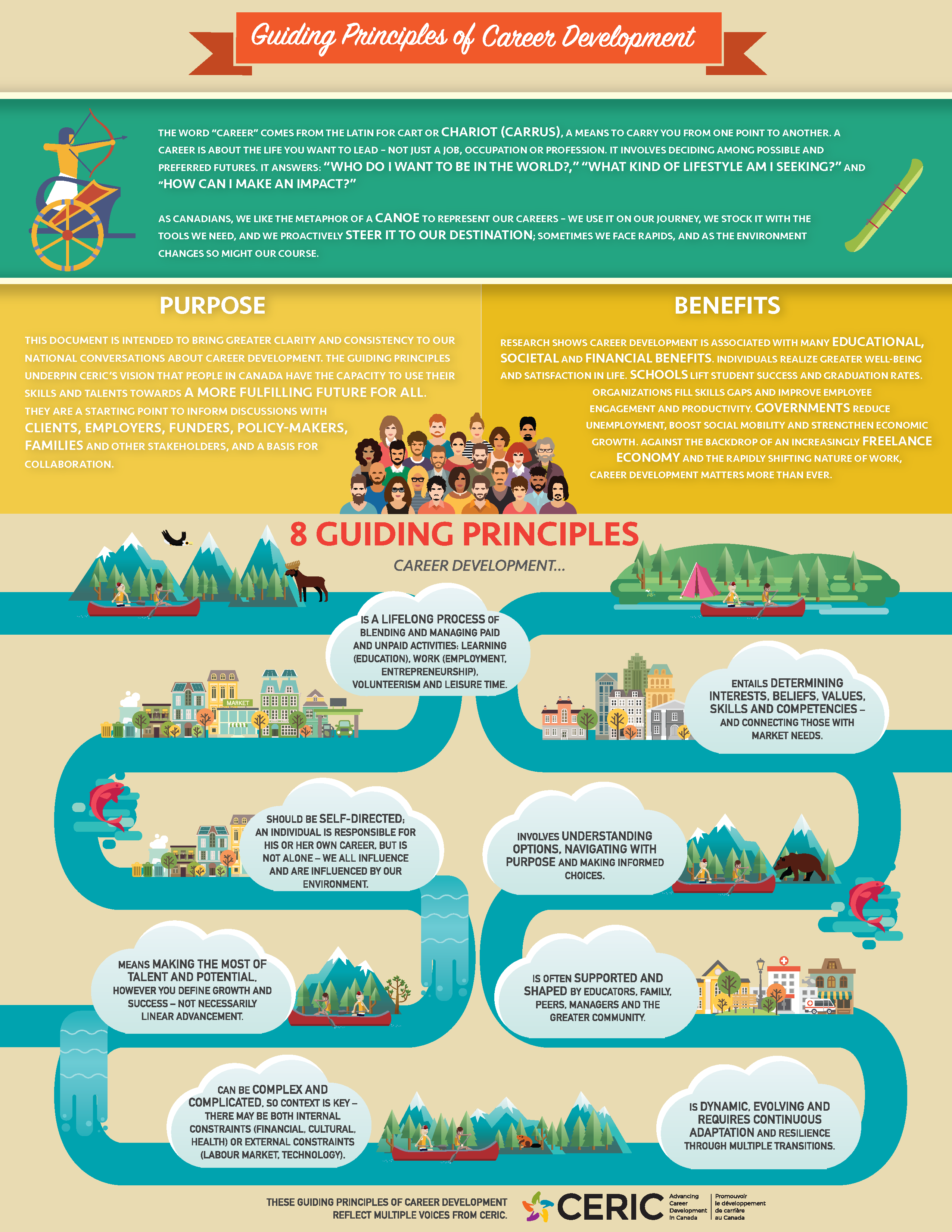
Ceric’s guiding principles describe career development as a lifelong process that blends learning, work, volunteerism, and leisure; it is self-directed, shaped by educators, peers, managers, families, and communities, and not necessarily a linear climb upward. Mark Savickas’s work on career adaptability adds that people need concern, control, curiosity, and confidence to navigate changing work conditions and career transitions:
People construct careers through actions that implement their self-concepts and manifest their vocational interests in work roles. Viewing career construction as a series of attempts to fit a self into work roles concentrates attention on adaptation to repeated transitions from school-to-work, from job to job, and from occupation to occupation. This adaptation is motivated and guided by the goal of bringing inner needs and outer opportunities into harmony. Adaptation, or goodness of fit, is indicated by success, satisfaction, and stability.
Put plainly, a career is not only built by getting the next job. It is built by noticing what each experience teaches, translating that learning into evidence, and using it to make better choices.
Here are five ways to make careering in the flow of work happen.
Clarify the career question
Careering in the flow of work starts with clarity. Whether we’re career-building as individuals or as part of a system, like a company or school, people need to know where to focus limited learning time to build the right skills and knowledge. Instead of asking, “What should I do with my life?” or “What is my passion?” ask, “What capability do I want to build next?” or “What experience would help me test whether I am interested in becoming a learning strategist or event planner?” This makes career development smaller, less intimidating, and more actionable in the flow of work every day.
Clarity does not mean locking into a single path. Career development is dynamic and requires adaptation through multiple transitions. Savickas’s career adaptability framework reinforces this by treating curiosity and confidence as career resources, not personality traits reserved for a few people. A useful career question creates direction without limiting self-discovery.
Collect signals and stories
Treat people as career data. Albert Bandura’s social learning theory emphasizes that people learn by observing others, especially through attention, retention, reproduction, and motivation. Communities of practice enable similar outcomes: people who share a domain or concern learn how to do it better through regular interaction, stories, tools, and shared practice. Career insight often comes from watching how someone works, listening to how they explain their choices, and asking what their experience has taught them. We do this every day, but might not reflect on – or focus – these interactions on career development.
A school-based example makes this practical. Imagine a student hears a guest speaker talk about event planning. Instead of treating the session as a one-time presentation, the student listens for career signals: What problems does the speaker solve? What skills do they use? What surprised them about the field? Afterward, the student writes down one job insight, one skill to explore, and one follow-up question. That is careering in the flow of school: a normal class experience becomes a low-risk career investigation.
This mindset is also inspired by on of the best to ever do it, Wade Davis (professor and Explorer in Residence), whose commencement reflections frame career as something that grows “step-by-step, choice-by-choice, and experience-by-experience,” and emphasize that many people, including those outside obvious expert roles, can teach us something. In career terms, this means the peer, supervisor, client, colleague, and even a taxi cab driver’s work story can become part of one’s career curriculum.
Convert experience into evidence
Experience alone does not automatically become career development. David Kolb’s decades-old and weirdly-still-relevant experiential learning cycle explains why: learning moves through concrete experience, reflective observation, abstract conceptualization, and active experimentation. In plain language, we do something, reflect on it, draw a lesson, and test that lesson in a future situation. Careering in the flow of work depends on this conversion process.
For the student who heard the guest speaker, the evidence might be a short reflection: “I learned that event planners need stakeholder management, budgeting, contingency planning, and calm communication.” The student can then map that insight to a future action, such as volunteering to help coordinate a school event. For an employee, the evidence might be a project note, a skill tag, feedback from the boss to write shorter emails, or a development goal focused on technology. The key is to capture the connection between experience and the capability it developed.
Technology can support this conversion. My organization uses Oracle Fusion HCM and its Skills Center, which allows employees to add skills to a profile, identify skills they have or want to develop, and receive suggestions based on job, career interests, peer skills, and existing skills. LinkedIn Learning and really good spreadsheets can achieve the same functions and outcomes. Career development becomes more visible when everyday experiences are translated into skills, competencies, and development goals.
Create small career experiments
I love experiments because they test possible futures through small wins and fails. Planned happenstance theory argues that career paths are shaped by unexpected events, and that people can create opportunities by acting with curiosity, persistence, flexibility, optimism, and risk-taking.
Personal and professional growth in service of community needs often involves luck. Mentors, sponsors, friends, stakeholders, or a new boss can open unexpected doors, create new networks, and accelerate career opportunities. Planned happenstance is the practice of cultivating this kind of opportunity through curiosity, action, and openness, which often requires experimentation. Careering in the flow of work encourages people to recognize, create, and make the most of unexpected opportunities rather than relying only on linear plans or online job applications.
Suppose an employee completes a GenAI course because they want to become a learning strategist or project manager. Rather than stopping at course completion, they use the learning immediately: they ask an AI assistant to help turn course notes, partner inputs, and project goals into a first draft of an experience plan. The employee then reviews the draft, improves it, and asks a manager or mentor for feedback and an opportunity to test the idea.
This is not “AI doing the career work.” It is a career experiment. The person is testing whether they enjoy designing experiences, translating learning into action, and coordinating outcomes with others. If the draft plan becomes useful, it can become evidence of emerging capability. If it does not, it still teaches something about fit, interest, and next steps.
Curate a career record
Careering in the flow of work requires a place to put the evidence. Find a place that brings together career development, skills, learning, connections, journeys, jobs, and gigs so employees can see learning recommendations for their current role and roles they aspire to grow into. Every organization needs a platform that supports development plans and development goals for workers. These systems matter because career growth becomes easier to discuss when skills, interests, goals, and experiences are documented. Individuals need a portfolio that showcases their work and, to say the least, never before have more options existed for sharing career stories (back in my day it was blogs and the Basketball Jones Podcast!).
The goal is not to over-systematize a human career. The goal is to make growth visible and clear enough so people can act on opportunities when they have time and when they have a need or question. A living career record might include skills documented in an HR system, learning paths in LinkedIn Learning, reflective notes from school or work experiences, AI-assisted drafts, and examples of applied work from your supercool podcast. Together, these artifacts help employees and students tell a clearer story about who they are becoming and where they want to go next.
Start careering today
Careering in the flow of work is the practice of turning ordinary experiences into career insight, skill evidence, and future possibility. It borrows from learning in the flow of work thinking, but shifts the focus from “How do I learn this now?” to “What does this experience teach me about my future?” This approach makes career development smaller, more social, more reflective, and more actionable for individuals and communities alike.
The most important mindset shift is the one Wade Davis underscores: careers grow through choices and experiences, and much more of life can teach us than we usually notice. Careering in the flow of work invites us to notice more deeply and then to act more purposefully.